Appendix O: Submission Package Instructions #
This appendix provides practical instructions for preparing a complete and reviewable submission package for the Missing Middles Sacramento Three & Up Challenge™. It is intended to help contestants organize their boards, narrative, feasibility materials, and required files in a clear and consistent format.
This appendix supplements the Official Rules & Regulations, Competition Brief, public appendices, and any issued addenda. It does not replace those documents. Contestants are responsible for reviewing and complying with all official competition materials.
A separate Round One Submission Checklist is provided through the competition portal. Contestants should use that checklist before upload to confirm that all required files, drawings, calculations, naming conventions, anonymity requirements, AI disclosure requirements, and feasibility materials are complete.
Purpose of This Appendix #
The purpose of Appendix O is to help contestants avoid common submission issues and prepare materials that can be evaluated fairly by the jury. The submission package should allow jurors to understand the design concept, selected site conditions, unit strategy, compliance logic, feasibility assumptions, and relationship to Sacramento without searching for missing information.
A successful submission should be:
- Complete
- Anonymous
- Legible
- Internally consistent
- Based on the official prototype lots
- Supported by clear drawings and diagrams
- Accompanied by a separate narrative PDF
- Accompanied by a feasibility PDF generated through the Missing Middles Feasibility Engine
1. Required Submission Package #
Round One submissions must include the following files:
- Four A2 landscape presentation boards in PDF format
- One separate narrative PDF
- One separate feasibility report PDF
- Required anonymous file naming
- No identifying information or metadata
The required files are:
MM2026-####_Board01.pdf
MM2026-####_Board02.pdf
MM2026-####_Board03.pdf
MM2026-####_Board04.pdf
MM2026-####_Narrative.pdf
MM2026-####_Feasibility.pdf
Replace “####” with the assigned Anonymous Entry ID. Do not add team names, project names, school names, firm names, alternate numbering systems, initials, extra characters, or other identifiers to the file names unless directed by Sponsor.
A four-page Submission Board Template is provided at the end of this appendix to illustrate a suggested layout for the four A2 presentation boards. The template is a recommended starting point, not a requirement. Contestants may adapt the layout as needed, provided all required content described below is included.
2. Site Selection Confirmation #
Contestants must use the official prototype lots provided in Appendix F: Site Selection & Neighborhood Information. Do not use self-selected sites, unrelated parcels, generalized lot diagrams, or invented site conditions unless expressly permitted by Sponsor through the official competition documents or an issued addendum.
Each submission must identify:
- One eligible site area or neighborhood
- One official interior lot condition
- One official corner lot condition
- The official lot codes for both selected lots
- Zoning designation
- FAR maximum
- Lot dimensions
- Alley condition, if applicable
- Required setbacks and frontage conditions
The lot codes should appear clearly on the boards and should be referenced in the narrative where the site strategy is described. Refer to Appendix F for prototype lot dimensions, zoning, FAR, alley condition, setback diagrams, site area maps, neighborhood context, and lot-specific reference information.
The intent is not to design two unrelated projects. Contestants should show how one housing concept adapts across both an interior lot and a corner lot condition. The two buildings may differ, but they should clearly belong to the same design family.
3. Recommended Board Organization #
Contestants may organize their boards as needed, provided all required content is included. The following structure is recommended to improve clarity and reduce the risk of missing information.
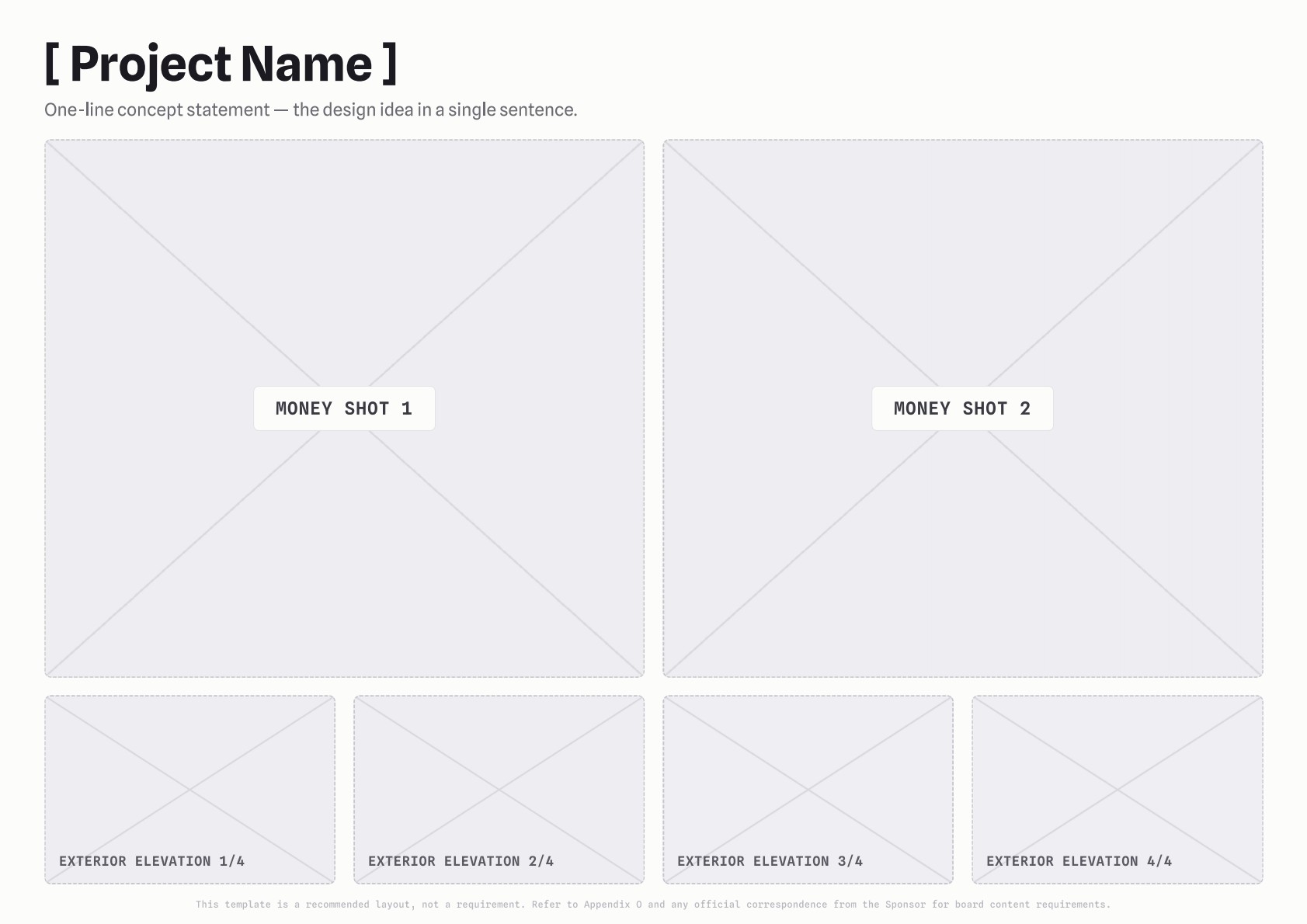
The Submission Board Template at the end of this appendix illustrates how this recommended board organization can be laid out across the four A2 boards, including suggested placement for the concept statement, money shots, site plans, floor plans, sections, the bulk plane or 3D envelope diagram, and the zoning compliance summary table. The template layout is a recommendation only; the required content described below takes precedence over any layout shown in the template.
Board 01: Concept, Perspective, and Exterior Character #
Board 01 should introduce the project and communicate the overall design idea.
- Project name
- One-sentence concept statement
- Required architectural perspective, or “money shot”
- Exterior character studies
- Primary elevations or frontage diagrams
- Key design moves
- Human-scale view of the building in its street or primary open-space context
This board should help the jury quickly understand the design intent, architectural character, and visual identity of the proposal.
(Click Image to Enlarge)
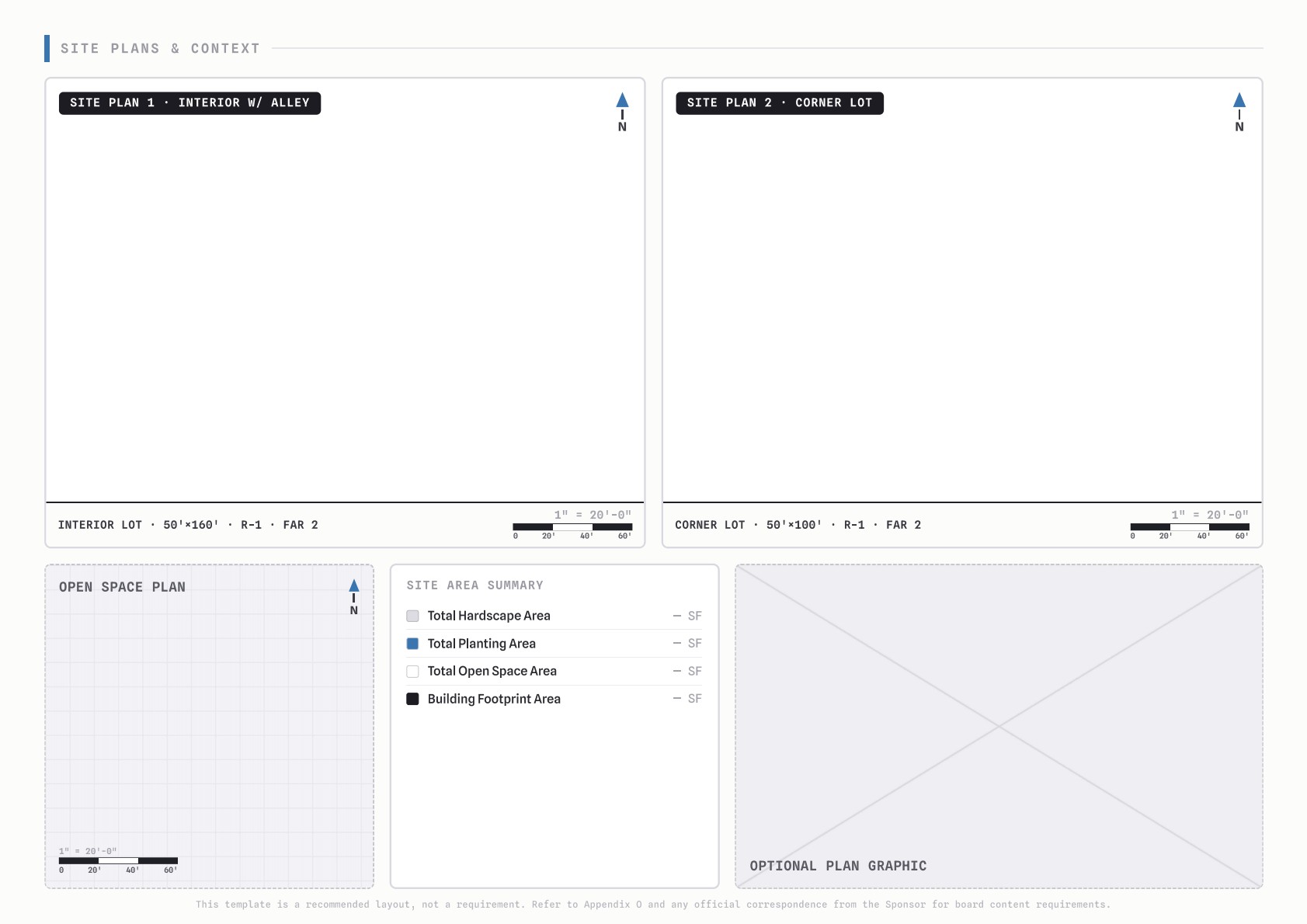
Board 02: Site Plans and Context #
Board 02 should show how the proposal works on the selected prototype lots.
- Interior lot site plan
- Corner lot site plan
- Official lot codes
- Parcel boundaries
- Lot dimensions
- Required and proposed setbacks
- Building footprints
- Primary entries and pedestrian access
- Parking strategy, if parking is provided
- Alley access, if applicable
- Open space areas
- Landscape and hardscape areas
- Tree locations and shade strategy
- Stormwater or green infrastructure strategy, if applicable
- North arrows and graphic scale bars
This board should make the site logic clear. The jury should be able to understand how residents arrive, how open space is organized, how the building relates to the street, and how the design adapts between the interior and corner lot conditions.
(Click Image to Enlarge)
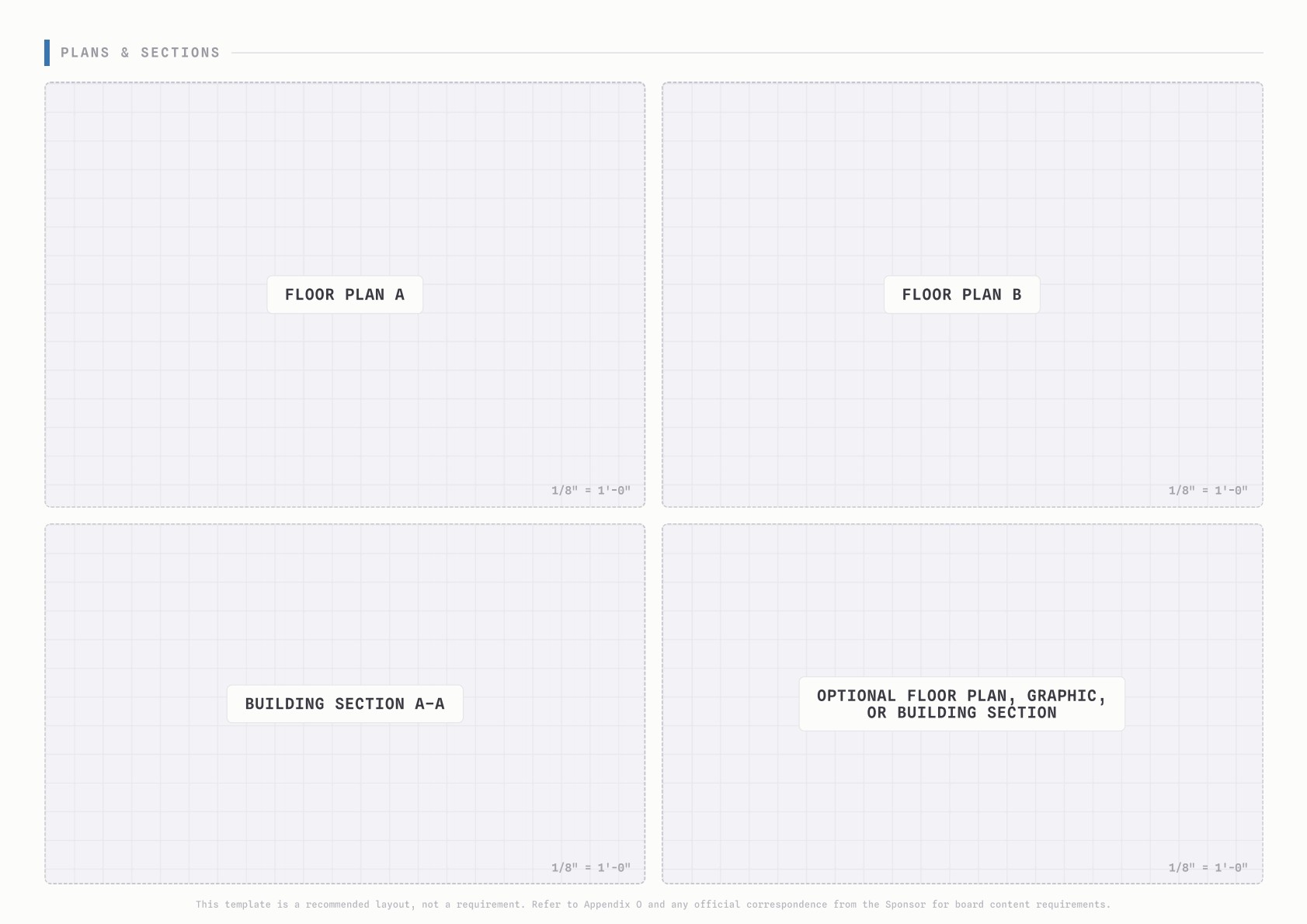
Board 03: Floor Plans and Building Section(s) #
Board 03 should explain how the housing works.
- Floor plans for all levels
- Unit labels
- Unit count and unit types
- Room names
- Door and window locations
- Circulation paths
- Overall building dimensions
- Gross square footage per unit
- Total gross building area
- At least one building section
- Floor-to-floor heights
- Overall building height
- Relationship to grade
- Roof form
This board should allow jurors to understand livability, unit organization, circulation, and the relationship between building form and interior space.
(Click Image to Enlarge)
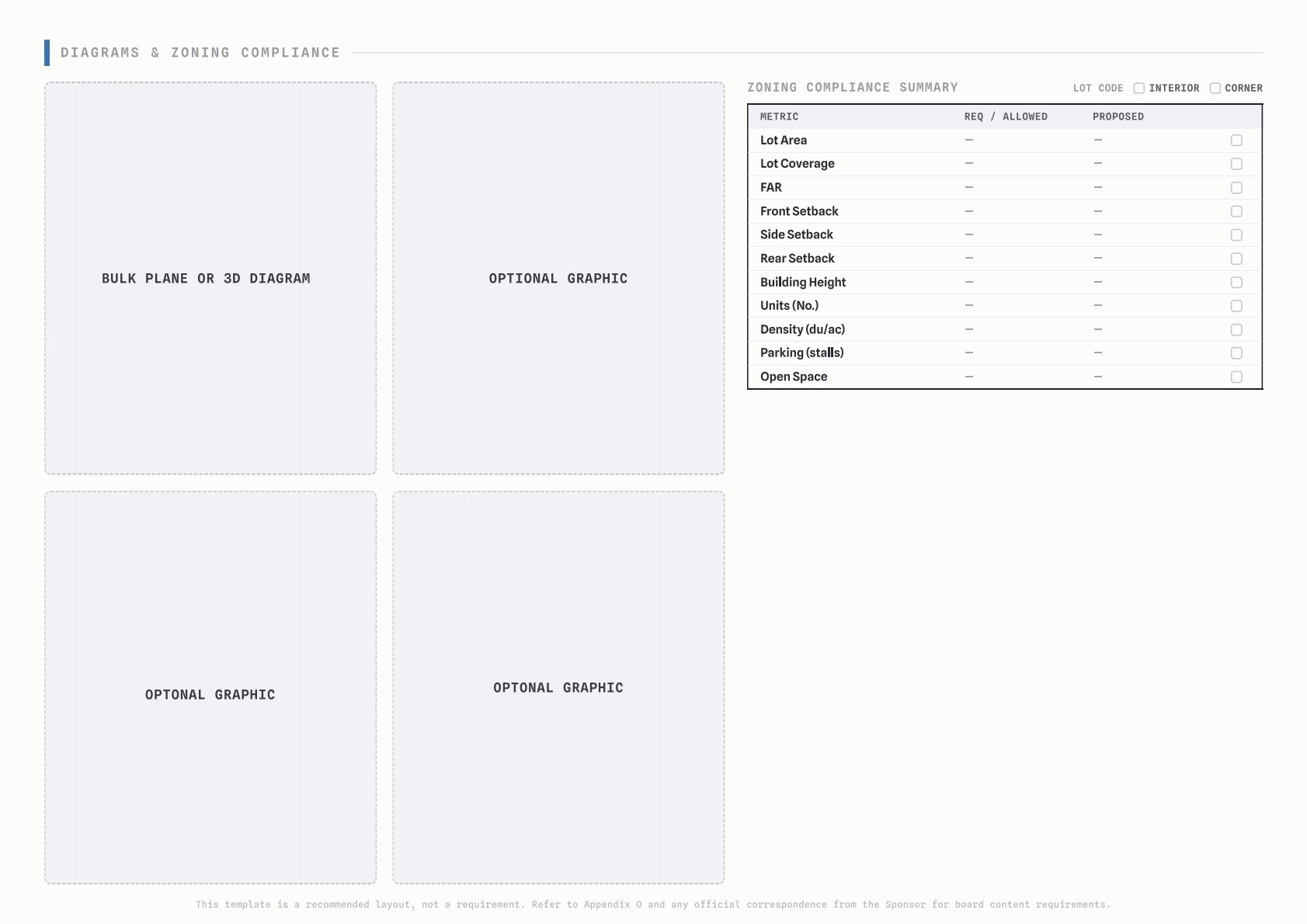
Board 04: Diagrams, Compliance, and Feasibility Signals #
Board 04 should consolidate the technical and regulatory logic of the proposal.
- Bulk plane or 3D envelope diagram
- Zoning compliance summary table
- FAR calculation
- Open space calculation
- Required versus proposed setbacks
- Height limit versus proposed height
- Unit count
- Parking summary, if applicable
- Lot coverage, if applicable
- Feasibility signals from the Missing Middles Feasibility Engine
- Diagrams explaining repeatability, construction logic, environmental strategy, or life-cycle housing strategy
Optional graphics may be included where they clarify the proposal. Optional graphics may not substitute for required drawings, compliance information, or feasibility materials.
(Click Image to Enlarge)
4. Drawing Clarity and Graphic Standards #
Submissions are schematic, but they must be legible and coordinated. Drawings should be clear enough for jurors to evaluate design quality, site response, spatial organization, compliance, and feasibility logic.
All scaled drawings should include:
- Drawing title
- Stated scale
- Graphic scale bar
- Key dimensions
- North arrow, where applicable
- Clear labels
- Legible text
- Consistent graphic conventions
Plans should include enough dimensions and area information to support the compliance table and feasibility output. If the submission includes a total gross building area, that number should correspond to the floor plans. If the compliance table lists setbacks, FAR, height, or open space, those values should be traceable to the drawings.
Avoid submitting boards that rely only on renderings or conceptual diagrams. Strong visual communication is encouraged, but required drawings and compliance information must remain clear.
5. Narrative Instructions #
The narrative must be submitted as a separate PDF. It should be concise, specific, and consistent with the boards and feasibility materials.
The narrative should not be a general policy essay. It should explain the design decisions, site response, tradeoffs, and feasibility logic of the submitted proposal.
The narrative should address the following topics:
Design Intent: Describe the organizing concept and primary design moves.
Site Response: Identify the selected prototype lots and explain how the proposal responds to lot dimensions, orientation, frontage, alley condition, setbacks, and neighborhood context.
Unit Mix and Yield: Summarize the unit count, unit types, approximate unit sizes, and intended housing program.
Building Organization: Explain the massing, circulation, entries, open space, and relationship between the interior lot and corner lot versions.
Attainability Strategy: Describe how the proposal supports attainable housing through density, unit size, tenure strategy, construction logic, repeatability, cost awareness, or other design decisions.
Life-Cycle Housing and Universal Design: Explain how the proposal supports changing household needs, aging in place, accessibility, multigenerational living, caregiving, or adaptability over time. Refer to Appendix N for the broader life-cycle housing and aging framework.
Green Building and Environmental Design: Describe the proposal’s approach to shade, heat mitigation, passive design, water efficiency, planting, stormwater, material durability, energy performance, or other environmental strategies.
Feasibility and Repeatability: Explain how the design could plausibly be built, repeated, or adapted across similar Sacramento infill conditions.
Relationship to Sacramento: Connect the proposal to Sacramento’s neighborhoods, climate, housing needs, transit context, and missing middle policy framework.
The narrative should support the drawings. If a claim is important, it should be visible in the boards, diagrams, or feasibility materials.
6. Missing Middles Feasibility Engine #
The Missing Middles Feasibility Engine is a protected conceptual feasibility and compliance workbook provided to help contestants test and document basic development logic. It is intended to support more consistent comparison across submissions and help contestants understand how site selection, unit mix, building geometry, zoning compliance, construction assumptions, fees, and market assumptions interact.
The tool is supported by predefined market information and locked reference assumptions developed for the competition. These assumptions draw from neighborhood sales context, land-signal analysis, rental market guidance, multifamily market information, underwriting benchmarks, prototype lot data, and RSMeans-derived Rough Order of Magnitude cost references. The intent is to provide a consistent early-stage feasibility framework, not to require each contestant to independently build a market study, cost estimate, or pro forma from scratch.
The Missing Middles Feasibility Engine uses the selected prototype lot pair, including one interior lot and one corner lot, as the basis for testing a proposal. Contestants enter project information such as unit mix, building area, building geometry, parking strategy, construction type, open space, setbacks, and other compliance inputs. The tool then helps summarize how the proposal performs against key zoning, cost, market, and feasibility indicators.
The tool includes predefined market assumptions related to land acquisition, neighborhood market position, rent support, unit configuration, building type, quality tier, parking condition, operating assumptions, valuation benchmarks, and financing assumptions. These assumptions are intended for competition-level comparison and scenario testing. They should be treated as conceptual market guidance, not as appraisals, formal market studies, or final underwriting conclusions.
The tool also includes RSMeans-derived cost information organized around major building systems and site-related categories. These may include foundation, exterior walls, roof assembly, windows, doors, framing, interior walls, stairs, mechanical, electrical, plumbing, fire protection, interior finishes, accessibility, site development, and related construction components.
Selected assemblies and finish tiers may affect Rough Order of Magnitude cost outputs, environmental performance indicators, and green score results. Examples may include higher-insulation wall assemblies, higher-performance windows, upgraded roof or envelope strategies, different door and glazing assumptions, finish selections, accessibility components, and site-development choices. These inputs help contestants understand how design and construction decisions can affect both cost and climate response.
The tool also includes Sacramento-related fee and cost assumptions, including permit, impact fee, utility fee, and related development cost references where applicable. These assumptions help translate design proposals into more complete early-stage development cost summaries.
The Missing Middles Feasibility Engine may be used to:
- Record the selected prototype lot pair
- Test unit mix and yield
- Compare interior and corner lot performance
- Review gross building area and FAR
- Track zoning compliance inputs
- Support the compliance summary table
- Consider open space, parking, and tree requirements
- Test high-level construction and cost assumptions
- Evaluate selected building assemblies and finish tiers
- Estimate permit, impact fee, utility fee, and related development cost assumptions
- Apply predefined land, rent, operating, valuation, and financing assumptions
- Summarize build-to-rent and build-to-sale scenarios
- Generate the feasibility PDF required for submission
The feasibility output should be used as supporting evidence. It does not replace drawings, diagrams, narrative, or required compliance information.
The Missing Middles Feasibility Engine is not a final construction estimate, appraisal, financial opinion, lender-ready underwriting model, market study, or guarantee of cost, approval, revenue, return, or project performance.
Contestants remain responsible for checking their assumptions and ensuring the feasibility materials align with the submitted design. Detailed instructions for operating the Missing Middles Feasibility Engine are provided separately through the competition portal.
7. Anonymity, File Naming, and Metadata #
The competition is judged anonymously. Submissions must not include identifying information.
Do not include:
- Personal names
- Team member names
- Initials or monograms
- Firm names
- School names
- Studio names
- Logos
- Signatures
- Watermarks
- Social media handles
- Email addresses
- QR codes
- Embedded links
- Cloud links
- Acknowledgments
- Author names or organization names in file metadata
- Revision histories, comments, or file properties that reveal identity
Use only the assigned Anonymous Entry ID where identification is required. Before submitting, contestants should remove metadata from all PDF files and confirm that no identifying information appears in the boards, narrative, feasibility PDF, file names, title blocks, images, or document properties.
8. Portal Checklist and Final Upload Review #
The Round One Submission Checklist is provided through the competition portal as a separate upload review tool. Contestants should use it after the boards, narrative, and feasibility PDF are complete and before the final upload is confirmed.
At minimum, contestants should confirm:
- All six required PDF files are included
- The official Appendix F lot codes are shown and match the selected site pair
- The boards include required drawings, diagrams, calculations, and compliance information
- The narrative is submitted as a separate PDF and supports the drawings
- The feasibility PDF is generated through the Missing Middles Feasibility Engine and aligns with the design
- File names follow the required convention exactly
- The submission is anonymous and metadata has been removed
- All files open correctly, are legible, and comply with portal upload requirements
The portal checklist is not a substitute for the Official Rules & Regulations. In the event of conflict, the Official Rules & Regulations govern.
9. Common Submission Issues to Avoid #
Contestants should avoid the following issues:
- Using self-selected sites instead of official Appendix F prototype lots
- Failing to identify official lot codes
- Designing only one lot condition instead of both an interior and corner lot
- Providing two unrelated schemes rather than one adaptable concept
- Missing site plans, floor plans, elevations, building section, or bulk plane / 3D envelope diagram
- Missing dimensions, stated scales, or graphic scale bars
- Missing gross square footage per unit or total gross building area
- Missing FAR calculation or open space calculation
- Showing open space without dimensions
- Submitting a compliance table with values that do not match the drawings
- Placing the narrative only on boards instead of submitting it as a separate PDF
- Missing the feasibility PDF or submitting feasibility assumptions that do not match the design
- Submitting pixelated, compressed, or unreadable boards
- Including names, schools, firms, logos, links, QR codes, or metadata
10. Closing Guidance #
The jury should be able to review the submission as a coordinated package. Boards, narrative, compliance information, and feasibility output should all support the same proposal.
A strong submission does not need to solve every housing problem. It should clearly explain what it is trying to do, who it is designed to serve, how it responds to the selected prototype lots, how it complies with the applicable standards, and why its development logic is plausible.
The goal is to submit a project that is not only visually compelling, but complete, clear, grounded, and reviewable.
Official Document Notice: This page is provided for reference only. The official and governing version of this material is contained in the Appendix O PDF.